
A wood floor costs more than carpet or laminate on the day it is fitted. Everything below is about what you get back for that difference — and about the handful of rooms where we would tell you to spend the money on something else. We supply and fit wood floors across South East London, so we see how they look on the day and how they look five years later.
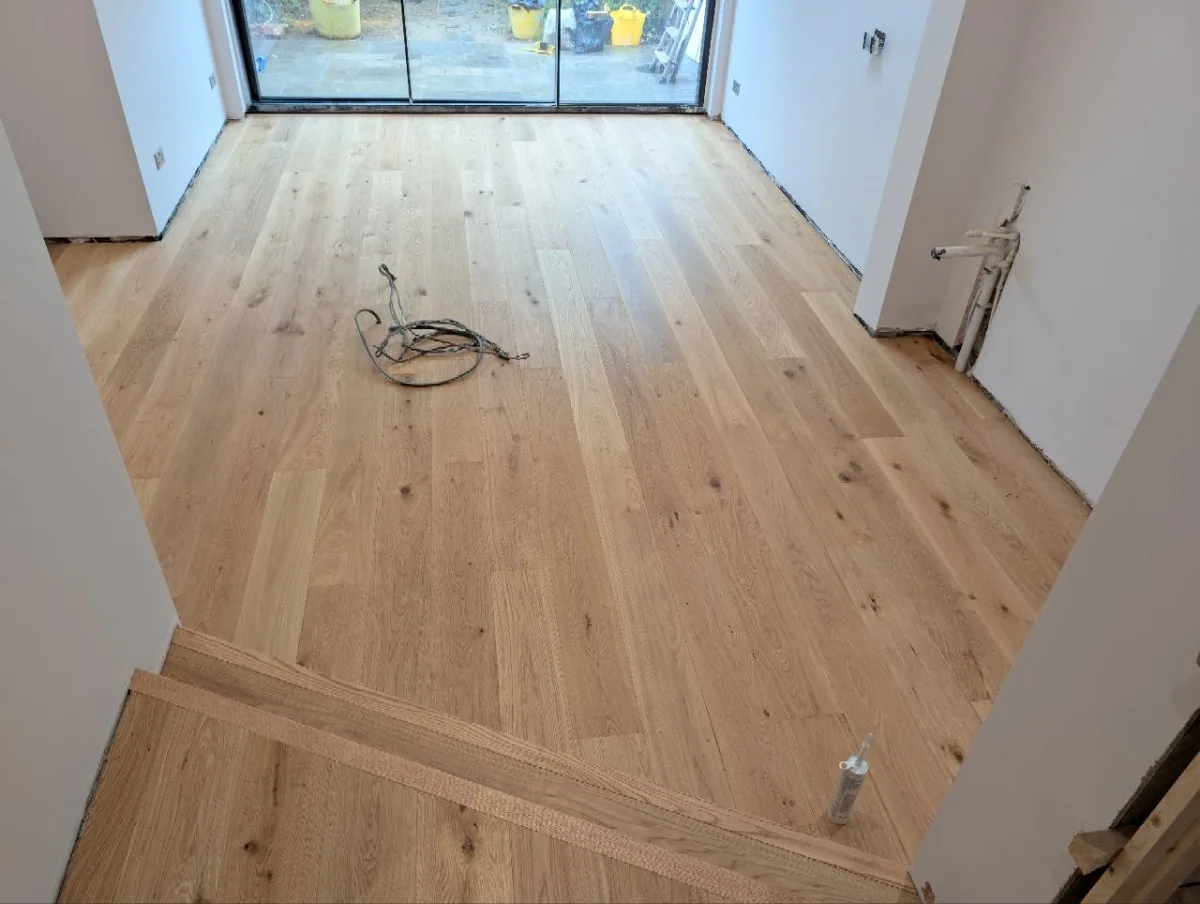
The real advantage: a wood floor can be renewed
Carpet and laminate are consumables. When a carpet wears in the doorways it is replaced; when laminate swells at a joint or the print wears through, the whole floor comes up, because neither can be repaired in place. Wood is different. The surface can be sanded back to bare timber and finished again, and the room looks new without a skip outside.
How many times you can do that depends on the wear layer — the thickness of real timber above the plywood core. Across the floors we stock:
- 2–3 mm — 32 floors. Roughly two full sandings.
- 3–4 mm — 78 floors, the bulk of our range. Roughly three.
- 4–6 mm — 10 floors. Four or more.
A full sand takes off something between half a millimetre and a millimetre, so a 3 mm layer is good for decades of ordinary family use. Solid boards give you more timber again above the tongue, which is why Victorian oak and pine floors are still in service in houses around us.
What a wood floor actually costs
There are 134 floors on this site and 86 of them carry a price. Per square metre, excluding VAT, they run from £22.00 to £117.75, and the median floor is £47.99. That is the spread:
| Price per m² (ex VAT) | Floors | What sits there |
|---|---|---|
| Under £35 | 12 | Clearance lines — Plumb Slate engineered oak plank is £22.00 while it lasts |
| £35 – £50 | 47 | The middle of the range, where most people buy |
| £50 – £70 | 25 | Wider boards and heavier wear layers — Wide Natural engineered oak is £67.49 |
| Over £70 | 2 | Black American Walnut at £83.99 and Versailles solid oak parquet panels at £117.75 |
Fitting is quoted separately, because it depends on what is under the floor rather than on what goes on top of it. We check the subfloor and take a moisture reading before we price a job — a level chipboard floor and a damp concrete slab are not the same piece of work, and pretending otherwise is how quotes get revised halfway through.
It is easier to live with than carpet
Dust, grit and pet hair sit on top of a wood floor instead of settling into a pile, so they come up with a vacuum or a dry mop rather than staying in the room. Spills wipe off a lacquered or oiled surface if you get to them reasonably soon. There is no annual carpet clean and nothing to shampoo.
The honest qualification: wood marks. A dog’s claws, grit tracked in from the street and a dropped pan will all leave a trace, and a high-gloss finish shows every one of them. Matt lacquer and a brushed or lightly textured surface hide day-to-day wear far better, which is why most of what we sell is finished that way.
Wood in London houses and flats
Two things decide the specification here. Flats are usually concrete, often with underfloor heating, and engineered boards handle both: the plywood core barely moves as the heating cycles, so the floor stays flat and the joints stay closed. Period houses are usually timber joists, where the question is whether the existing floor is level enough to lay over or needs boarding out first.
Both are worth settling before you choose a colour. A floor laid over a subfloor that is too wet or too uneven will tell you about it within a year, and no finish hides that.
Where we would tell you not to use wood
- Bathrooms, shower rooms and wet rooms. Standing water and wood are a bad combination whatever the finish.
- Rooms with an unresolved damp problem. Fix the damp first; a new floor will not survive it and will hide it while it gets worse.
- Solid boards over underfloor heating. Solid timber moves too much with the heat cycle. Engineered is the right answer here, not solid.
- A floor you expect to lift again soon. If the room is due to be rebuilt in a year or two, fit something cheap now and the wood afterwards.
Solid or engineered?
For most houses in South East London the answer is engineered, and not because it is cheaper — it is simply more stable over concrete and under heating, and a 3–4 mm wear layer outlives most owners’ plans for the room. Solid earns its place where the subfloor is timber, the room is heated conventionally and you want a floor that can be sanded many times over a very long life.
The comparison is set out in full on our engineered wood flooring page and on the solid wood page, including when solid is genuinely the better buy.
Where to start
Where the range currently sits:
- Engineered oak and walnut — the main range, priced from £22.00 to £83.99 per m² ex VAT
- Herringbone — 41 floors, 25 of them priced, from £25.99 per m²
- Sale and clearance — the cheapest way into a real wood floor while stock lasts
Colour is almost impossible to judge on a screen. You can order up to three samples free and look at them in your own light, come and see full boards at the showroom on Malham Road in Forest Hill, or send your room measurements and we will come back with quantities and a fitting cost.